
Peptide Injectables vs. Peptide Creams: Which Authority Regulates What in the UAE?
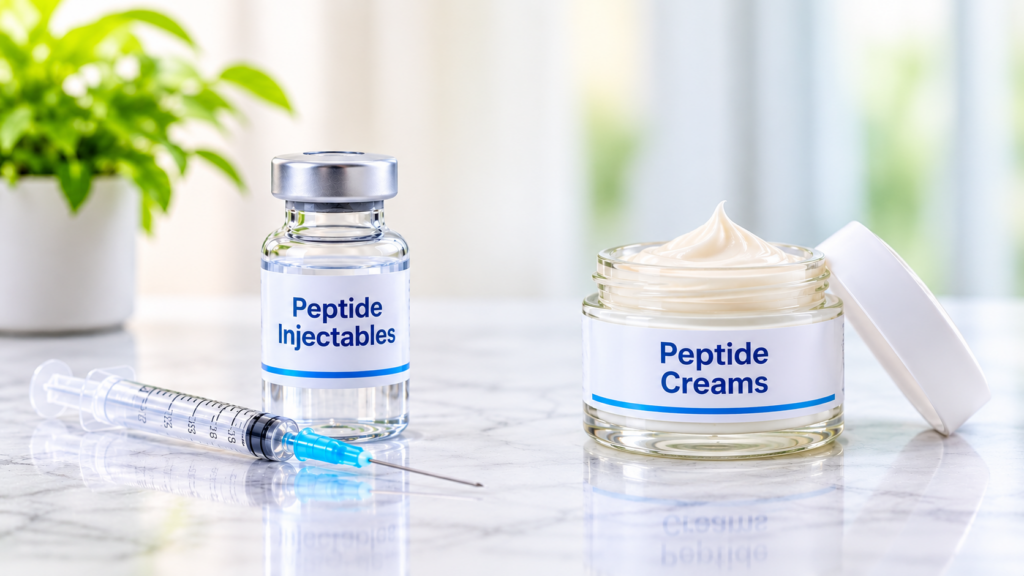
Peptides are one of the most talked-about categories in the UAE health and wellness market right now and also one of the most actively enforced. In August 2026, the Emirates Drug Establishment flagged 71 unapproved sources of peptide products and announced legal action against fourteen social media influencers for promoting unregistered peptide therapies. In the same month, both the Dubai Health Authority and the Abu Dhabi Department of Health issued formal regulatory circulars setting out mandatory requirements for how peptide products must be handled across all healthcare facilities. The UAE’s regulatory environment for peptides has never been more clearly defined or more actively monitored. This guide cuts through the complexity and explains exactly which authority regulates peptide regulation in the UAE, which pathway applies to topical peptide creams versus injectable peptide therapies, and what businesses and healthcare providers need to know before they bring any peptide product into this market.
Why Peptide Regulation in the UAE Is a Pressing Issue Right Now
The UAE’s peptide market has grown rapidly, driven by global trends in biohacking, anti-ageing aesthetics, and the crossover between cosmetic and medical treatments. Social media channels have amplified the market and the risk. Unregistered injectable peptides being promoted by influencers, compounding pharmacies dispensing unapproved peptide formulations, and consumers self-administering research-grade peptides have all been identified by UAE authorities as active public health concerns.
The regulatory response has been coordinated and multi-authority. The Dubai Health Authority issued Circular CIR-2026-00000107 in July 2026, providing guidance regarding the handling of peptide products within healthcare institutions. The Abu Dhabi Department of Health released Circular 148/2026 on 31 July 2026, creating an official risk-based system for overseeing the peptide products according to their mode of administration, mechanism, and clinical evidence base. The EDE followed with its own enforcement actions. For any business or healthcare professional operating in the UAE peptide market, understanding this framework is now a compliance prerequisite, not a background consideration.
How the UAE Classifies Peptide Products: The Risk-Based Framework
The DoH Circular 148/2026 introduced a formal risk-based classification that now underpins peptide regulation in the UAE. Products are assessed on the basis of their route of administration, whether they have systemic effects on internal organs, and whether sufficient clinical evidence exists to support their use. This produces two broad categories:
Low-Risk: Topical Cosmetic Peptides
Topical peptide products, creams, serums, and gels applied to the outer surface of the skin are classified as low-risk when they do not penetrate to systemic circulation and when they are positioned and labelled as cosmetics with appearance-based claims. These products remain on the existing cosmetic regulatory pathway. They are registered with Dubai Municipality through the Montaji platform and are subject to the standard cosmetic registration requirements: a Cosmetic Product Safety Report, INCI ingredient declaration, Certificate of Free Sale, GMP certificate, stability data, and bilingual Arabic and English label artwork. The risk-based framework does not create a new pathway for low-risk topical peptides; it confirms that the existing Montaji cosmetic pathway is the correct and sufficient route.
Medium and High-Risk: Therapeutic and Systemic Peptides
Peptide products with systemic effects including all injectables, peptides with clinical effects on internal organs, regenerative therapies, and products based on emerging or insufficient clinical evidence are classified as medium- or high-risk. These products are subject to enhanced regulatory controls: they require a federal marketing authorisation from the Emirates Drug Establishment, emirate-level oversight from the DHA (for Dubai) or DoH (for Abu Dhabi) for their use within healthcare facilities, and full product traceability across the supply chain. Unapproved medium- or high-risk peptide products cannot be imported, dispensed, or administered in the UAE under any circumstances.
UAE Peptide Regulation: Which Authority Covers Which Product?
Here is a clear reference map of peptide regulation in the UAE by product type:
| Peptide Product Type | Risk Level | Regulating Authority | Registration / Approval Pathway |
|---|---|---|---|
| Topical peptide serum or cream (cosmetic claims) | Low | Dubai Municipality (CPSS) | Montaji cosmetic registration |
| Topical peptide cream with therapeutic claims | Low → Medium | MOHAP / EDE for classification + DM if cosmetic | MOHAP classification first, then EDE or DM pathway |
| Injectable peptide therapy (prescription) | High | EDE (federal) + DHA or DoH (emirate) | EDE marketing authorisation + emirate healthcare facility oversight |
| Peptide administered by a compounding pharmacy | High | EDE + DHA or DoH | EDE-authorised API import + compounding pharmacy licence + DoH/DHA approval |
| Peptide food supplement (non-therapeutic claims) | Low | Dubai Municipality (CPSS) | Montaji health supplement registration |
| Peptide for scientific research (in-vitro only) | N/A (not for human use) | MOHAP | MOHAP Circular 17/2022 research-use framework not a marketing authorisation |
Topical Peptide Creams and Serums: The Dubai Municipality Pathway
Standard peptide skincare products, anti-ageing serums, firming creams, and recovery formulations containing cosmetic peptides such as Matrixyl, Argireline, GHK-Cu, or SYN-AKE are registered as cosmetics with Dubai Municipality via Montaji. The cosmetic classification applies when the product is applied topically, does not claim systemic biological effects, and its label claims describe appearance outcomes rather than physiological mechanisms.
The critical compliance obligation for topical peptide creams under UAE peptide regulation is claims management. Topical peptide products that use language suggesting they stimulate collagen synthesis, regenerate skin cells, inhibit neurotransmitter activity, or function as alternatives to injectable treatments are pushed out of the cosmetic category and into the pharmaceutical classification requiring EDE registration instead of or in addition to Montaji registration. The controlling claim requirements are per GSO 2528:2024, and the authorities of UAE have clearly made digital enforcement applicable to the influence marketing content along with the product content.
Practical consideration for topical peptides: The 2026 enforcement actions against influencers and unauthorized peptide sources have created a risky situation for the peptides industry. Even if your topical peptide cream is correctly registered as a cosmetic, any promotional content whether by your brand or by third-party creators that describes it in the language of injectable therapy will attract regulatory scrutiny. Review all influencer briefs and digital marketing assets against cosmetic claim boundaries before publication.
Injections for Peptide Therapy: The EDE and Healthcare Facility System
Peptide injection therapy constitutes one of the most highly regulated categories of drugs in the UAE’s pharmaceutical regulation. According to the Federal Decree-Law No. 10 of 2025, every therapeutic peptide to be injected must have an effective marketing authorization from the Emirates Drug Establishment. This requirement applies regardless of whether the peptide is a commercial product or a compounded formulation. Unauthorised injectable peptides cannot legally reach patients through any channel.
The EDE Marketing Authorisation Requirement
An EDE marketing authorisation for an injectable peptide requires a full CTD/eCTD pharmaceutical dossier including clinical safety and efficacy data, a UAE-based Marketing Authorisation Holder with a licensed medical warehouse, a pharmacovigilance plan with a locally qualified pharmacovigilance officer, and bilingual labelling and patient information materials. For peptides already approved by reference regulatory authorities the EMA, FDA, TGA, or MHRA a verification or reliance pathway may be available, potentially reducing review timelines. Novel peptides or those approved only in non-reference jurisdictions require a more extensive assessment.
DHA and DoH: Emirate-Level Healthcare Facility Oversight
In parallel with EDE federal registration, the administration of injectable peptide therapies in clinical settings is subject to emirate-level oversight. The DHA’s Circular CIR-2026-00000107 outlines detailed guidelines for the documentation, storage, prescribing, and administration of peptides in healthcare institutions in Dubai. The DoH’s Circular 148/2026 requires similar compliance in Abu Dhabi, where there is a requirement for patient consent in peptide therapy, prescriber requirements, tracking the peptides all the way from receiving the drug until administering the drug, pharmacovigilance requirement, and no administration of peptide therapy merely by social media trend.
Compounding Pharmacies: A Critical Compliance Zone
Compounding pharmacies have been recognized to be one of the most risky access points in the UAE’s peptide regulation enforcement system. The EDE has confirmed that it is conducting extensive inspections of compounding pharmacies across the UAE specifically to verify that no unapproved peptide products are being dispensed. The 2026 enforcement actions were partly triggered by compounding pharmacies preparing injectable peptide formulations including Retatrutide, which EDE explicitly confirmed has not been approved for marketing or medical use in the UAE and dispensing them without proper regulatory authorisation.
A compounding pharmacy that wishes to legally prepare a peptide formulation must source the active pharmaceutical ingredient from an EDE-authorised importer, operate under a valid compounding pharmacy licence from the relevant emirate authority, and follow the DoH or DHA technical requirements for peptide product handling including traceability and pharmacovigilance documentation. Peptides cannot be compounded for human administration from research-grade materials; the API must have EDE-authorised pharmaceutical-grade status.
For healthcare providers in Dubai and Abu Dhabi: The July 2026 circulars from the DHA and DoH both introduce prescriber accountability obligations. Physicians who prescribe or administer peptide therapies are now required to document clinical justification for the therapy, obtain informed consent that specifically addresses the peptide treatment, and participate in pharmacovigilance reporting if adverse effects occur. These obligations apply to all peptide therapies meeting the medium-or-high-risk classification, not just novel or experimental ones.
Research-Grade Peptides: A Separate and Narrowly Defined Lane
A separate regulatory lane exists for peptides used exclusively for in-vitro laboratory research not for human use, not for animal use, and not for any clinical application. This lane is regulated under the MOHAP Circular 17/2022 and places stringent requirements including that research peptides should be labeled “For Research Use Only”, be brought into the country with valid MOHAP import permits, and not marketed or promoted for therapeutic use. The research-use framing is not a workaround for the EDE registration requirement; it is a narrowly defined channel that applies only to genuine scientific laboratory research. Any peptide marketed for human use even under a “research” label is treated as an unapproved pharmaceutical product and is subject to the full enforcement consequences the EDE has demonstrated in 2026.
How Hawkridge Corp Helps Peptide Brands Navigate UAE Regulation
The UAE’s peptide regulation landscape has undergone its most significant transformation in years over the last three months with multiple new circulars, an active enforcement programme, and clear authority demarcation between the EDE, DHA, and DoH. At Hawkridge Corp, we help brands, manufacturers, healthcare facilities, and distributors understand exactly where their peptide products sit within this framework and what they need to do to operate compliantly.
For topical cosmetic peptide brands, we manage full Dubai Municipality Montaji registration including pre-submission classification review to confirm the product sits on the cosmetic pathway, claims compliance assessment against GSO 2528:2024, and complete dossier preparation and submission. When it comes to the pharmaceutical peptides, we provide services of EDE marketing authorization, setting up Marketing Authorization Holder, and DHA/DoH health facility approvals. Our experts can also help our clients in revising current registrations and digital materials according to new regulations for the year 2026.
With the UAE actively enforcing peptide regulation and the consequences of non-compliance now including legal action against both suppliers and promoters, the time to clarify your regulatory position is before an enforcement action not after.
Final Thoughts
The answer to the question of which authority regulates what in UAE peptide regulation is now clearly defined and actively enforced. Topical cosmetic peptide creams and serums sit with Dubai Municipality and the Montaji cosmetic registration pathway, provided their claims remain within cosmetic boundaries. Injectable peptide therapies fall under EDE marketing authorisation at the federal level and DHA or DoH healthcare facility oversight at the emirate level, with full traceability and pharmacovigilance obligations attached. The compounding pharmacies can obtain only APIs authorised by EDE, and research peptides are a very thin road which does not lead anywhere into the realm of human therapeutics. The raid that hit the UAE in 2026 made the price tag for running a business in this regard quite clear. The smartest thing that you can do is to know what category your product falls into and follow the right regulatory path accordingly.